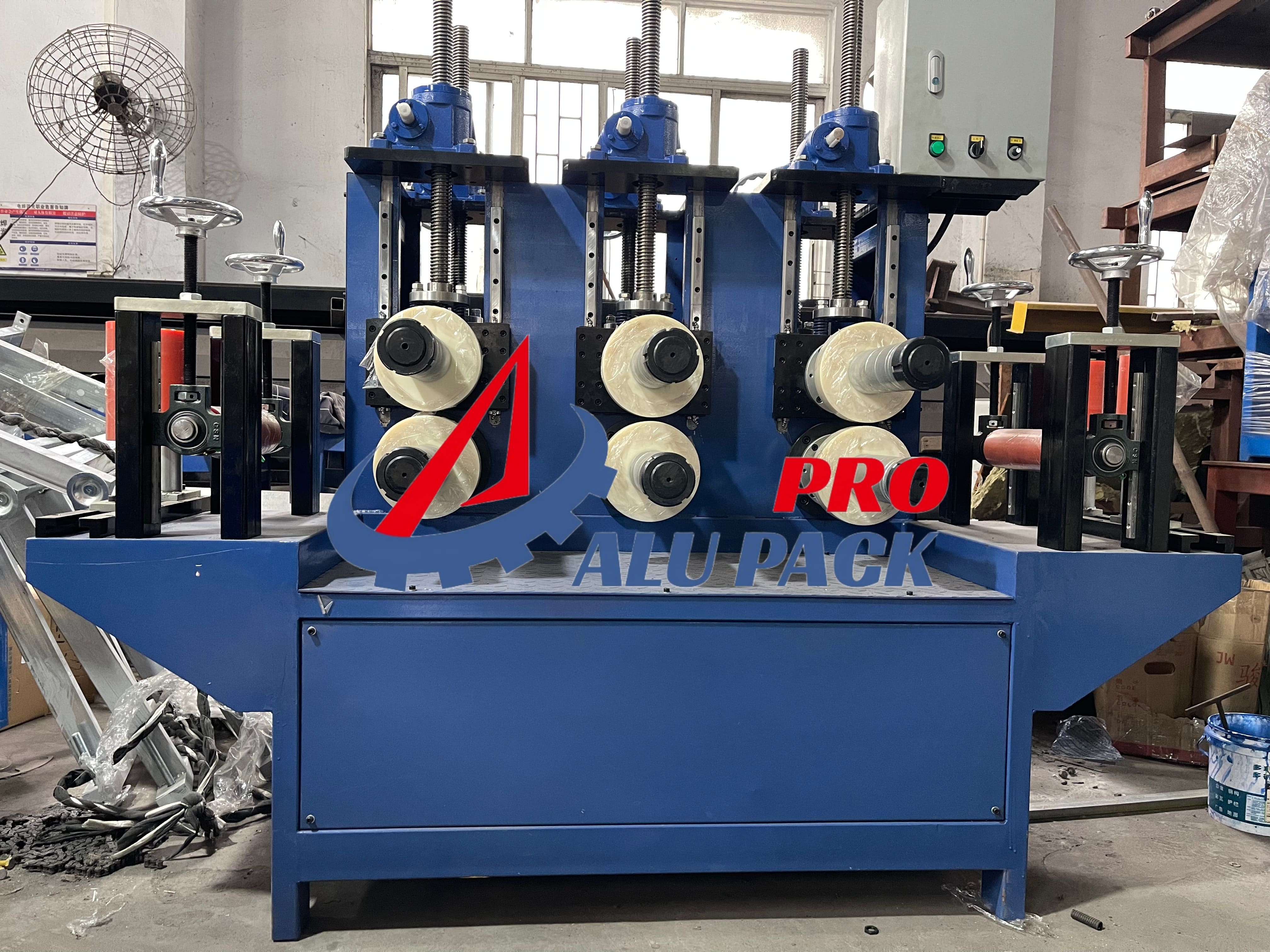
Nowadays, aluminum straightening machine, aluminum correction machine and aluminum surface shaping machine have become indispensable surface treatment equipment in the aluminum extrusion industry. An aluminum straightening machine is professional industrial equipment that applies controlled external force to produce reasonable plastic deformation on aluminum profiles, so as to calibrate geometric dimensions and improve overall shape accuracy.
Its working logic is based on the inherent plastic deformation properties of metal materials. After hot extrusion, natural cooling and subsequent handling, aluminum profiles are prone to bending, twisting, uneven flatness and angular deviation. At this time, the aluminum correction machine and aluminum straightening machine work together, applying accurate pressure and bending moment through rollers, pressure heads and shaping die sets. This process rearranges the internal residual stress of the profile and forms stable permanent deformation, making the finished profile reach standard straightness, flatness and cross-section tolerance. Meanwhile, the aluminum surface shaping machine further optimizes surface flatness and subtle contour errors, ensuring both dimensional precision and smooth surface texture.
The complete straightening and shaping process can be divided into three core stages. First, the detection system uses laser scanners or contact probes to identify bending, twisting and uneven positions of raw profiles. Second, the intelligent control system calculates the exact correction force and running stroke according to the detected deviation data. Third, hydraulic units, servo motors and mechanical screw actuators deliver precise pressure to finish calibration efficiently.
For special-shaped profiles and complex spatial angle deviation, the matched aluminum correction machine and aluminum surface shaping machine adopt multi-axis linkage interpolation technology. It can synchronously optimize straightness, parallelism, opening size and surface flatness in multiple dimensions. The whole working process relies on precise force control and stable deformation logic, effectively preventing over-correction, surface damage and material waste, and helping aluminum factories stabilize production quality and improve market competitiveness.