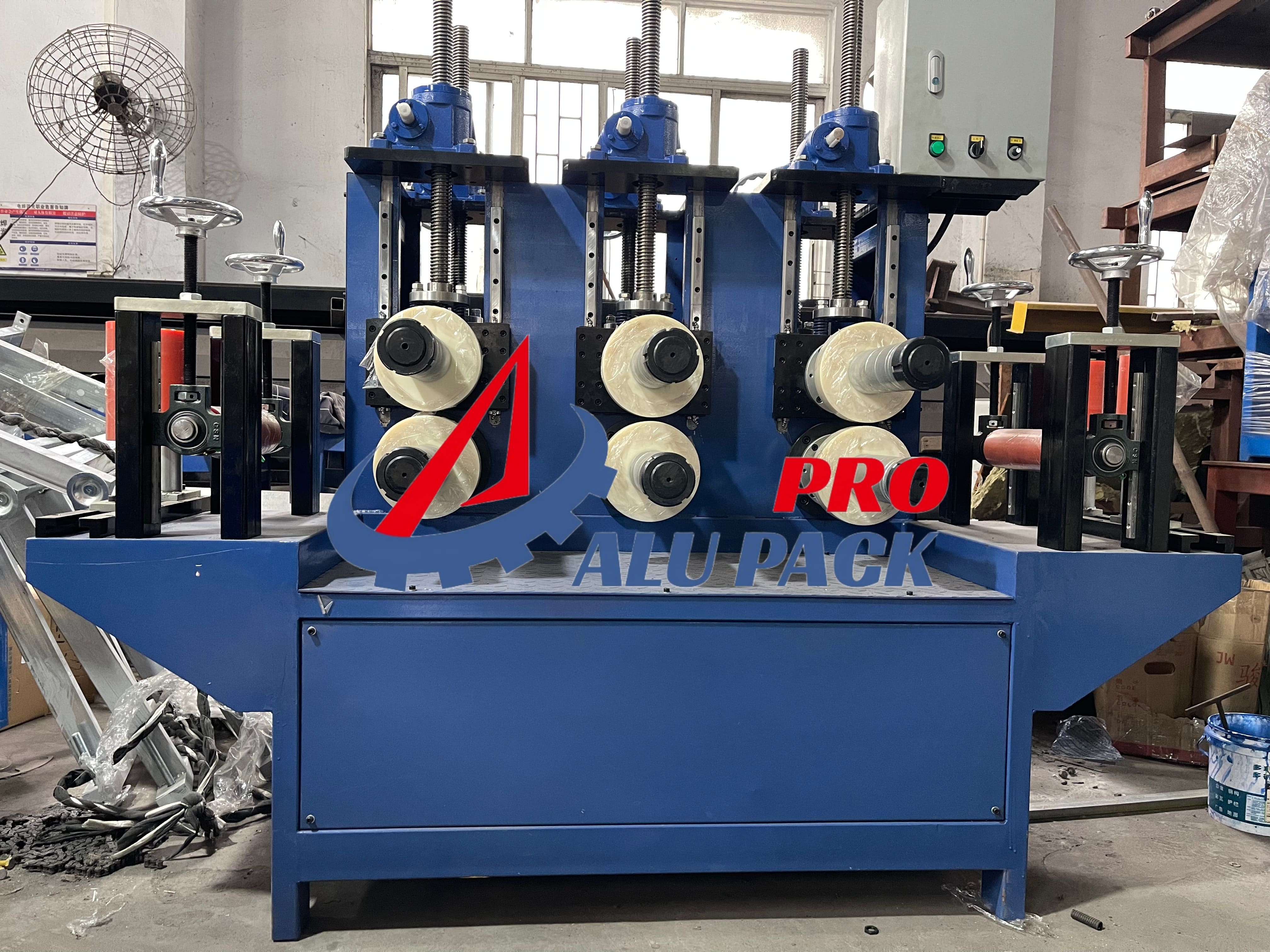
With the rapid development of architecture, automotive, photovoltaic and new energy industries, the demand for high-precision aluminum profiles and sheets is growing. Aluminum materials are prone to bending, twisting, waviness and warping during extrusion, quenching, transportation and cooling, directly affecting subsequent processing quality. As a key aluminum processing equipment, the aluminum straightening machine (also called leveling machine or aluminum correction machine) is irreplaceable for correcting deformations, eliminating internal stresses and ensuring precision. It is also a professional aluminum surface shaping machine that optimizes product flatness and straightness, providing qualified blanks for subsequent processing.
This article introduces the core applications, typical scenarios and working principle of the aluminum profile straightening machine, helping enterprises understand its value and select suitable solutions.
I. Core Applications of Aluminum Straightening Machine
The aluminum correction machine integrates straightening, shaping and stress relief, applicable to aluminum profiles, sheets and strips. Its core applications include three aspects:
1. Aluminum Profile Straightening and Shaping
As a professional aluminum surface shaping machine, it corrects common deformations of aluminum profiles from extrusion, cooling and quenching, including longitudinal bending, twisting and lateral bending, ensuring straightness and twist meet specifications. It also adjusts cross-sectional angles, flatness and dimensional deviations, critical for high-precision profiles like door/window, curtain wall and radiator profiles.
2. Aluminum Sheet/Strip Leveling and Stress Relief
For aluminum sheets and strips, the aluminum straightening machine eliminates waviness, warping and bulging before rolling, slitting and stamping, controlling flatness. It also releases internal stresses to prevent cracking, secondary deformation or dimensional drift during subsequent stamping, welding and anodizing, improving yield and product service life.
3. Precision Dimensions and Quality Assurance
The aluminum correction machine improves batch product consistency, reduces scrap rates, and meets high-precision requirements of high-end fields (door/window, automotive, photovoltaic, electronic heat dissipation). It solves manual straightening problems (low efficiency, poor precision, surface damage), realizing standardized, efficient straightening.
II. Typical Application Scenarios of Aluminum Straightening Machine
With strong adaptability and high precision, the aluminum straightening machine is widely used in aluminum processing. Typical scenarios:
- Architectural Aluminum Profiles: Corrects door/window, curtain wall and railing profiles. The aluminum surface shaping machine ensures excellent flatness and straightness for architectural needs.
- Industrial Aluminum Profiles: Straightens assembly line frames, brackets and rail transit profiles. The aluminum correction machine guarantees dimensional accuracy for stable equipment operation.
- Aluminum Sheets/Strips: Levels LED substrates, automotive sheet metal, heat sink fins and decorative panels, ensuring uniform flatness for subsequent processing.
- Precision Aluminum Components: Relieves stress and finishes thin-walled profiles, new energy battery trays and aerospace components. The high-precision aluminum straightening machine controls dimensional deviations and stresses.
III. Brief Description of the Working Principle of Aluminum Straightening Machine
The aluminum correction machine (aluminum straightening machine) corrects deformations via scientific mechanical principles: it uses multiple sets of upper/lower opposing pressure rollers (or hydraulic servo pressure heads) to apply continuous, controllable reverse bending to aluminum during conveying. Leveraging metal’s “Bauschinger effect” (yield strength decrease under reverse loading), the aluminum undergoes gradual curvature correction and stress homogenization. After precise roller adjustment, it achieves required flatness, straightness and cross-sectional precision.